




![settings.logos[0].icon](https://sigi-jordan25.s3.eu-central-1.amazonaws.com/877993618407682.png)

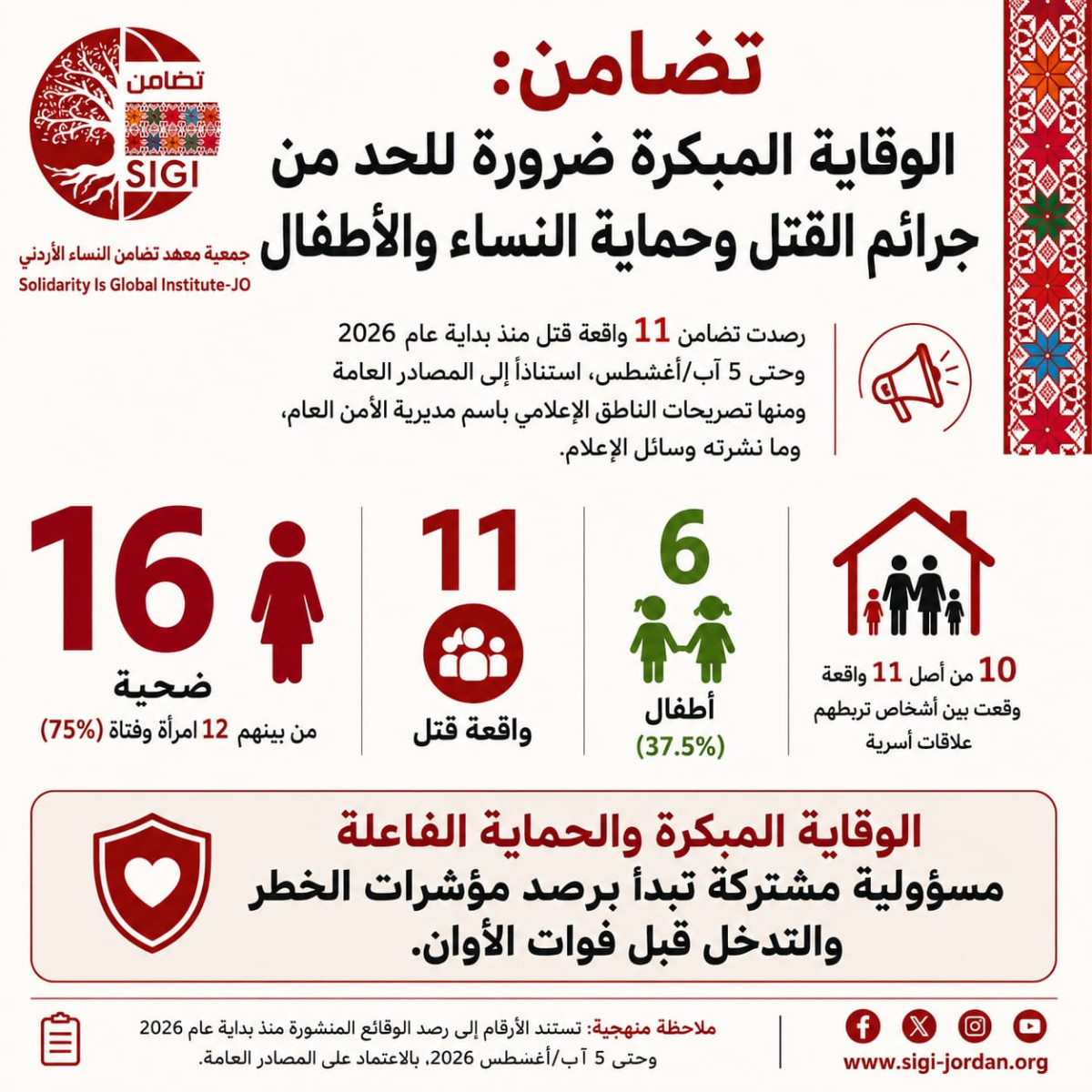
- 12 women and girls among 16 victims in incidents monitored since the beginning of 2026.
- Children account for 37.5% of the victims, with risk indicators calling for intervention before it is too late.
- Economic pressures and poverty may exacerbate risk factors, but they never justify violence.
- Supporting and sustaining civil society organizations is essential to maintaining prevention and protection services and facilitating access to services for the most vulnerable groups.
No to putting victims on trial after their deaths: stop searching through victims’ lives for reasons that explain or justify what happened to them.
The Jordanian Women’s Solidarity Institute (Tadamon) is following with concern the homicides that have occurred in Jordan since the beginning of the current year, particularly those taking place within family settings and involving women, girls, and children among the victims. Tadamon stresses that the recurrence of such incidents calls for continued development of all prevention mechanisms and tools, including the identification of risk indicators and early intervention before violence escalates and results in loss of life.
Through monitoring publicly available news, statements, and information from the beginning of 2026 through August 5, Tadamon recorded 11 homicide incidents resulting in the deaths of 16 people, including 12 women and girls and six children. Ten of these incidents occurred between individuals who were related by family ties. These figures raise serious concerns regarding risks that may threaten the fabric of Jordanian families and society.
The monitoring was based on a range of publicly available sources, including statements and information published by the spokesperson for the Public Security Directorate, as well as media reports covering the incidents in question.
Tadamon clarifies that these figures represent the incidents that could be identified and followed through available sources. They do not constitute official crime statistics or national rates and should not be used to generalize about Jordanian society or families.
Women and Girls Account for 75% of the Monitored Victims
Women and girls accounted for 12 of the 16 victims, representing 75% of the total number of deaths recorded in the monitored incidents. This figure warrants serious consideration from the perspective of the right to life, physical safety, and protection from violence.
Tadamon stresses that family disputes, regardless of their severity, never justify assault or the violation of the right to life. The existence of a family relationship between the parties does not make violence a private matter when the safety of a family member is at risk.
Early identification of risk indicators is therefore an essential component of prevention, particularly when there are repeated threats, previous incidents of violence, escalating severity of violence, or threats to harm other family members.
The presence of any of these indicators does not necessarily mean that a homicide will occur. However, taking them seriously and assessing them in a timely manner may help prevent the escalation of violence and protect people at risk.
Children Must Remain Outside Adult Family Conflicts
Tadamon expresses concern over the presence of six children among the victims, representing 37.5% of the total deaths monitored this year.
Children are not parties to adult conflicts and should never, under any circumstances, be used as a means of pressure, revenge, threats, or an outlet for anger. Any direct or indirect threat to harm them should be taken extremely seriously, with the level of risk surrounding them properly assessed.
The figures also show that only three incidents resulted in eight of the 16 victims—half of the monitored deaths—being killed in the same incidents. This highlights the importance of assessing the severity of violence not only by the number of incidents, but also by considering the possibility that more than one person may be harmed and the extent to which threats and risks surrounding a family are escalating.
Poverty and Economic Pressures: Factors That Must Neither Be Ignored nor Used to Justify Violence
Violence does not occur in isolation from the social, economic, and psychological circumstances surrounding individuals and families. When considering prevention measures, it is important to take into account the living pressures faced by some families, including poverty, unemployment, debt, difficulty meeting basic needs, and economic instability.
Tadamon notes that the accumulation of such pressures may increase levels of tension and vulnerability within some families, particularly when combined with other factors such as a history of violence, limited capacity to manage conflicts, substance use, repeated threats, or the absence of social support networks.
However, the Institute stresses the importance of avoiding any direct or inevitable link between poverty and violence. The vast majority of families experiencing difficult economic conditions do not engage in violence, and violent crimes are not limited to any particular social or economic group.
Accordingly, economic circumstances may form part of the broader environment of pressures surrounding certain cases, but they can never constitute a justification for assault or homicide, nor do they exempt perpetrators from responsibility for their actions.
Tadamon considers strengthening social protection networks, improving employment and income opportunities, providing psychological, social, and family support services, and helping vulnerable families cope with economic and social pressures to be development measures that also have significant preventive value in strengthening family stability and their ability to manage crises.
Protection Begins Before a Crime Occurs
Responding to violent crimes after they occur is essential to ensuring justice. However, prevention requires action at an earlier stage—when risk indicators first emerge and before lives are lost.
Tadamon commends the efforts of national, security, judicial, social, and health institutions involved in protection from violence. It stresses that continued development of coordination among these institutions and civil society organizations can strengthen timely response, referral, and follow-up, particularly in cases involving high-risk indicators.
The community also has an important responsibility: serious threats must not be minimized, repeated violence must not be normalized, and people at risk should be encouraged to seek assistance. Promoting peaceful and lawful approaches to managing conflicts and disputes can help protect family members and prevent disputes from reaching a point where their consequences become difficult to prevent or reverse.
No to Putting Victims on Trial After Their Deaths: Stop Searching Through Victims’ Lives for Reasons That Explain or Justify What Happened to Them
Tadamon points out that some homicide cases are followed by waves of narratives and speculation about the victim’s life or relationship with the perpetrator, particularly on social media. In some cases, this may develop into searching through the victim’s personal life for reasons that explain or justify what happened to them.
The Institute calls for respecting the dignity of victims and the privacy of their families, distinguishing verified information from circulating narratives, refraining from sharing unverified personal information, and avoiding directly or indirectly placing responsibility for the crime on the victim.
At the same time, Tadamon recognizes the important role of the media in exposing cases of violence and raising public awareness. It calls for continued professional and responsible reporting that protects the public’s right to know while respecting the rights of victims and their families.
Declining Funding May Create Gaps in Prevention and Protection Systems for the Most Vulnerable Groups
Civil society organizations are facing growing challenges related to declining funding and the sustainability of programs, at a time when there remains a continued need for awareness, prevention, support, referral, and community outreach services.
Tadamon considers civil society organizations to be an essential partner in the national protection system alongside official institutions, rather than a substitute for them. The expertise, knowledge, and capacity to reach women, children, families, and local communities that these organizations have built over the years represent a national resource that should be preserved.
The completion of a project or the discontinuation of funding for a program does not mean that the problem or need it was established to address has ended. A reduction in resources, in the absence of sustainable alternatives, may create gaps in prevention, awareness, outreach, and referral services, particularly for groups and communities that need them most.
Tadamon therefore calls for expanding partnerships among official institutions, civil society organizations, the private sector through corporate social responsibility, and donors; diversifying funding sources; and developing more sustainable models for prevention and protection programs. This would help preserve accumulated national expertise and reduce the dependence of essential services on the lifespan of a specific project or grant.
Prevention Is a Shared National Responsibility
Tadamon renews its call to view violence prevention as a shared national and societal responsibility, bringing together legislation, enforcement of and respect for the rule of law, social and economic protection, health, psychological and educational services, community engagement, and responsible media.
It also calls for continued investment in early intervention, increasing awareness of risk indicators, facilitating access to protection services, strengthening families’ capacity to cope with economic and social crises, and rejecting the normalization of any form of threat or assault.
Tadamon affirms that protecting women, children, and all family members from violence cannot be achieved through a single institution or intervention. Rather, it requires an integrated system that places the rights to life, safety, and human dignity at the heart of the response and works to prevent violence before it occurs just as much as it works to ensure justice after it occurs.
Jordanian Women’s Solidarity Institute (Tadamon)
10 August 2026
Tadamon: Early Prevention Is Essential to Reduce Homicides and Protect Women, Children, Families, and Community Safety
385
Leave a comment


